Will your money last after you stop working?
Five numbers give you a readiness score, the corpus you need and the chance your money lasts. Behind them is a year-by-year projection built for India: EPF, EPS and gratuity from your salary, both tax regimes every year, everything in lakh and crore.
- FY2026-27 tax rules
- EPF wage ceiling ₹25,000 from 17 Sep 2026
- 300 market scenarios
This is what a plan looks like
Asha is 35, earns ₹18 L a year, invests ₹32,500 a month and wants to retire at 60. These are her numbers, computed by the same engine that runs your plan. Example, not yours.
Your money lasts past 85 on the expected path. Keep the SIPs running and review once a year.
Every number above has this explanation behind it, and every assumption in it is yours to change.
Three screens, one answer
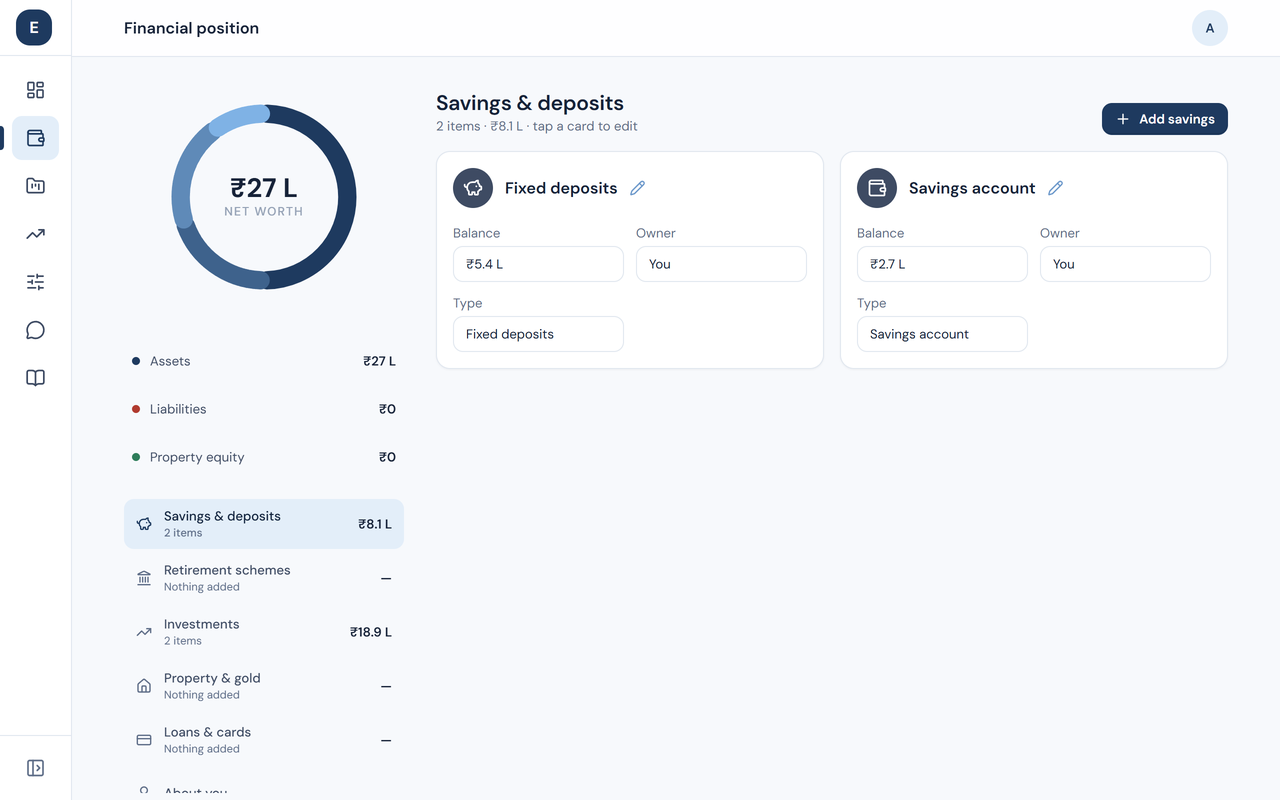
Everything you own and owe, in one place.
Accounts, EPF, PPF, NPS, loans, insurance and the people you support. Ten minutes to enter, saved as you go, editable any time.
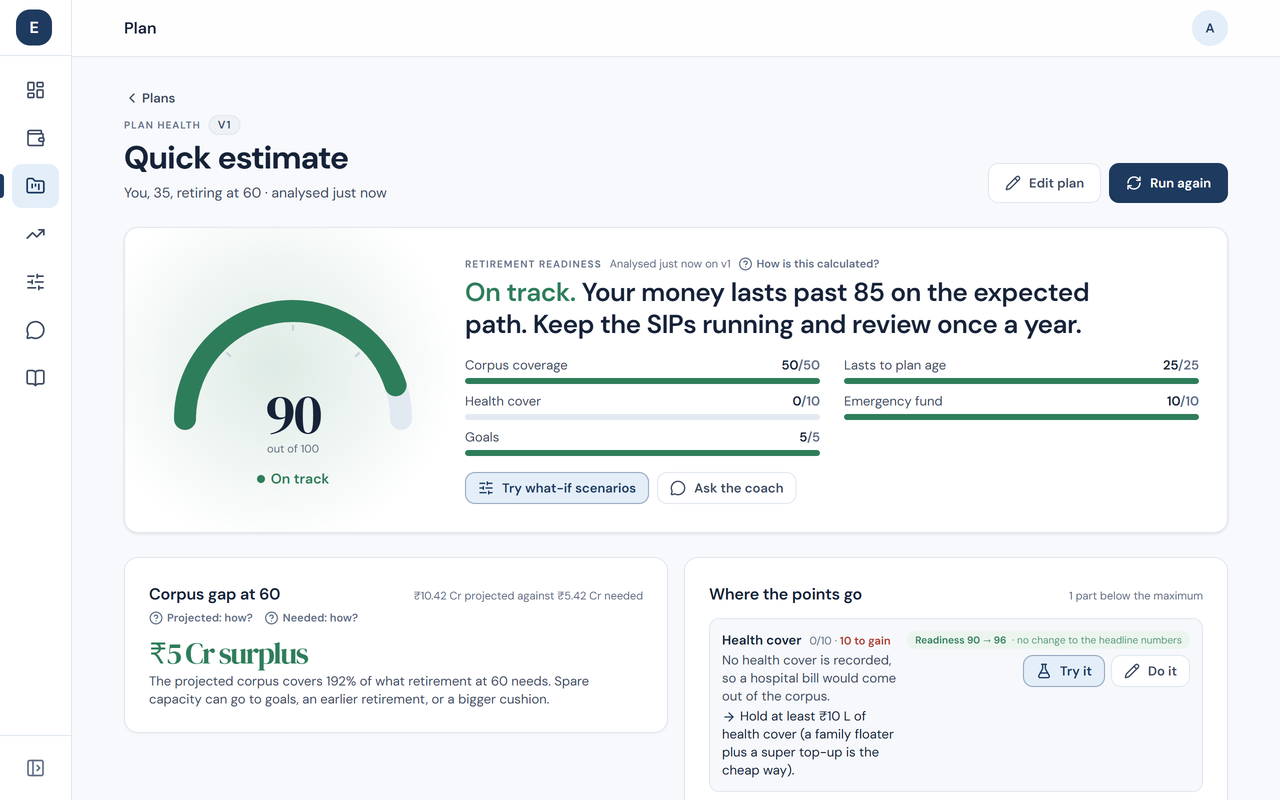
Set the targets. The plan does the rest.
Retirement age, how long to plan for, the lifestyle you want, the goals along the way. Make as many plans as you like and compare them.
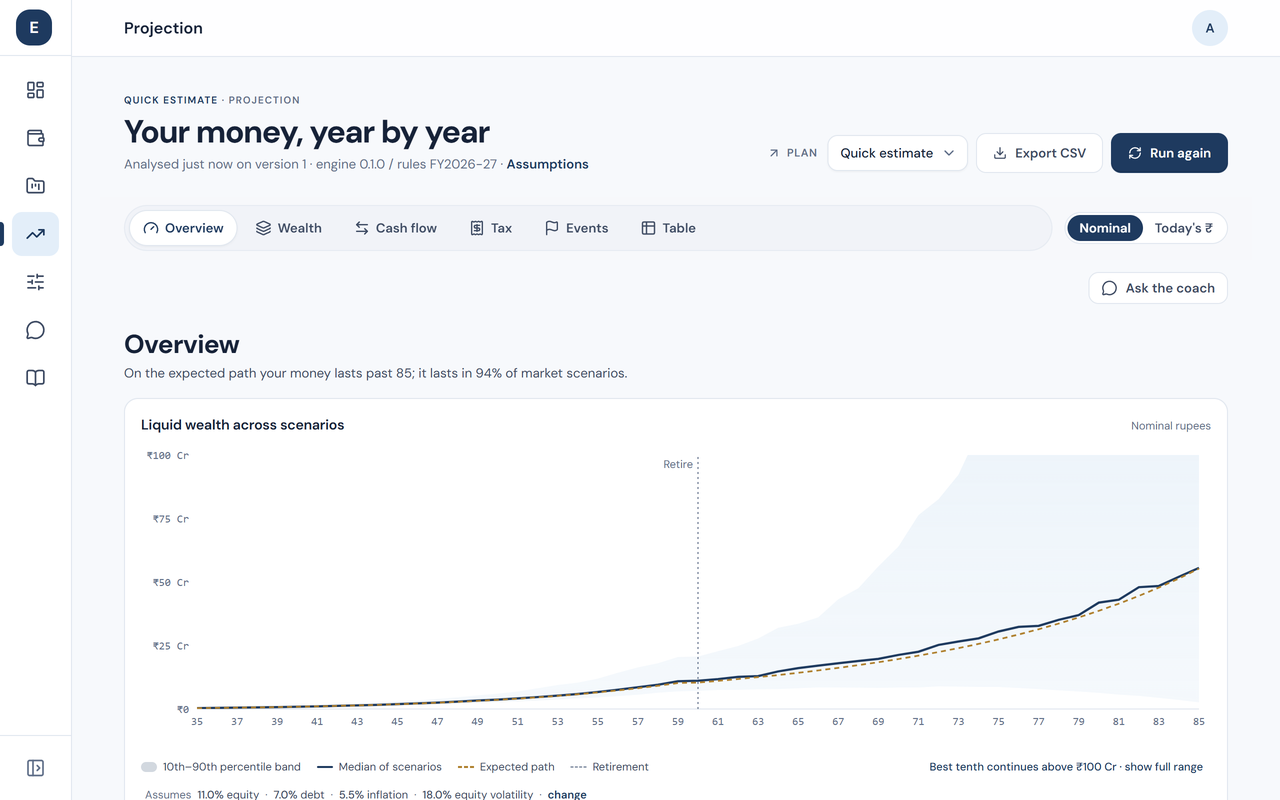
Year by year, until 85 or beyond.
Income, spending, tax, contributions and withdrawals for every year, the year the money runs short if it does, and the three changes that move the score most.


Built for how money works here
EPF, EPS and gratuity, automatically
From your basic pay and years of service: both PF shares at the EPFO rate, the EPS pension from 58, gratuity on the day you retire, and the ₹25,000 wage ceiling in force since 17 September 2026.
Both tax regimes, every year
Old and new regime computed for each year of your life with that year's deductions, and the cheaper one used. The regime can switch when a home loan ends; the plan notices.
Lakh, crore and Indian inflation
Amounts the way you say them. General inflation for living costs, medical inflation for health, education inflation for fees, each with its source.
Rules with dates, not guesses
Tax slabs, the 87A rebate, EPF, NPS exit rules, PPF and SCSS rates are held per tax year with the notification they come from. The next small-savings revision is due 1 January 2027.
Nineteen free calculators, no sign-in
Each one runs in your browser on the same FY2026-27 rules as the planner, and shows what most calculators leave out: the value after inflation, the tax you actually pay, and a year-by-year table.
- EMI calculator with prepaymentMonthly EMI, total interest and a year-by-year schedule for a home, car, personal or education loan, with what a prepayment saves and the tax you get back.Open
- SIP calculator with inflation, tax and step-upWhat a monthly SIP grows to, in today's money and after tax, with a yearly step-up and a probability band from 100 market paths instead of one flat return.Open
- Income tax calculator: old vs new regimeTax under both regimes for FY2026-27 with HRA, 80C, NPS, 80D and home-loan interest, which one wins, and how much more in deductions the old regime would need.Open
- Retirement calculator: will my money last?Five numbers give a readiness score, the corpus you need and the chance your money lasts, from a year-by-year projection with EPF, gratuity and both tax regimes. Free, no sign-up.Open
- EPF and EPS pension calculatorYour EPF balance at retirement with EPFO's interest method, the employee, employer and interest split, the new ₹25,000 EPS ceiling, and the monthly EPS pension in today's money.Open
- NPS calculator with exit and annuityNPS corpus at 60 on the Auto Choice glide path or your own mix, the lump sum you can take and the part that is taxed, the annuity it buys, and the 80CCD tax saved along the way.Open
Three steps, about half an hour
Step 1: Enter the facts
Income, savings, loans, insurance, family. Rough figures are fine; refine them later. Saved as you go.
Step 2: Set your targets
When to retire, how long to plan for, the lifestyle you want, the goals along the way. The plan builds itself from the facts.
Step 3: See what to change
The score, the year the money runs short, and the three changes that move it most. Try what-ifs, or ask the coach, who answers from your own plan.
What we ask for, and what we never do
- Your email, and the financial details you choose to enter. Never PAN, Aadhaar or bank account numbers.
- Your data is stored in India, used only to build your plan, and you can export or delete it at any time.
- No products, no funds, no insurers are recommended. Ever. The planner shows numbers and rules; what you buy is your decision.
- Every return, inflation and rate assumption is visible, sourced and editable. Nothing is hidden in a formula.
- Free. There is no paid tier, and no one is paid when you invest.
Write to [email protected] with questions or corrections.
If you want to understand it first
All articles- LearnWhy the "30 times" corpus rule — and where it breaksWhere the rule of thumb that you need about 30 times your first-year retirement spending comes from, why India needs a bigger multiple than the West, and how the planner computes your actual required corpus.
- LearnNew vs old tax regime — how to choose for FY2026-27The FY2026-27 slabs for both regimes, the ₹60,000 rebate that makes income up to ₹12 lakh tax-free in the new regime, and a simple way to tell which regime is cheaper for you.
- LearnHow Eazyretire calculates your plan — the method behind every numberWhat the planner actually does with your numbers: the year-by-year ledger, how tax is worked out under both regimes, how the corpus you need is computed, what the readiness score adds up, and what the 300 market scenarios mean.
Questions people ask
- Is Eazyretire free?
- Yes, entirely. The calculators need no account; the planner needs an email address. There is no paid tier and no commission on anything you buy.
- Is my data safe?
- You enter an email and the financial figures you choose; never PAN, Aadhaar or bank details. Data is stored in India, used only to build your plan, and you can export or delete it whenever you like. Sign-in is by a one-time code, so there is no password to leak.
- Does it work if I am self-employed or run a business?
- Yes. Choose self-employed or business owner and the plan leaves out EPF, EPS and gratuity, applies the right tax treatment, and works only from what you save.
- What about EPF, EPS, NPS and gratuity?
- They are computed from your basic pay and years of service and land on the right dates: EPF and gratuity on retirement, the EPS pension from 58, the NPS exit at 60 with its 60% tax-free rule. You can enter existing balances and see each one in the year table.
- Why 300 market scenarios?
- Because markets do not deliver the average every year. The plan is replayed 300 times with returns and inflation drawn around your assumptions with realistic swings, and reports how often the money lasts. It is a probability, not a promise.
- Can I change the assumptions?
- Every one of them: equity and debt returns, inflation by category, salary growth, volatility, the retirement lifestyle share, the bucket years. Each shows its source and its default, and a "used by my plan" filter hides the ones your plan does not touch.
- Is this financial advice?
- No. Eazyretire is a planning and education tool. It never recommends a product, fund, insurer or adviser. Decisions about what to buy are yours; the planner shows you the numbers and the rules behind them. Our guide explains when paid advice helps and how to check anyone.
- Does it work on a phone?
- Yes. The calculators and the planner work in any modern browser on a phone, with nothing to install.
Find out in a minute
Five numbers, no account, computed in your browser.